CLIENT INTAKE — LAW FIRMS
Your firm misses leads every night.
AI fixes that.
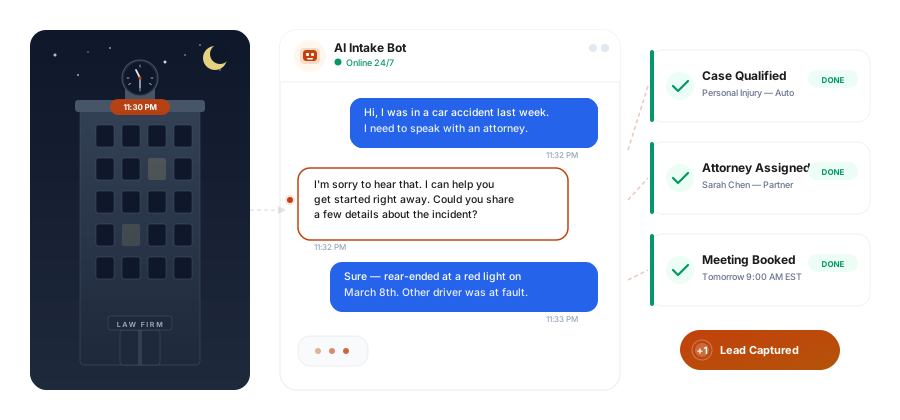
30–40% of client inquiries come in after hours. Most go unanswered until the next morning. This demo shows how AI handles intake 24/7 — routing clients to the right attorney, checking conflicts, and booking consultations automatically.
↓ Try the intake bot below
EXAMPLE ENGAGEMENT
A law firm like yours
8–15 attorneys · Professional services · 6-week engagement
WHAT WE TYPICALLY FIND
30–40% of client inquiries arrive after hours and go unanswered — a pattern we see across nearly every firm we audit
WHAT THIS DEMO SHOWS
The intake system we'd build as a Week 3 deliverable
HOW A YONGAI ENGAGEMENT WORKS
Before we build anything, we spend two weeks understanding how your firm actually operates. This demo is what Week 3 looks like.
Week 1–2: Discovery
Stakeholder interviews with attorneys, paralegals, and front desk. We map the full client intake journey — not from documentation, from observation.
Week 2–3: Analysis
We identify where time is lost, where revenue leaks, and which processes are worth automating. In most law firms, after-hours intake is the first thing we flag.
Week 3: This deliverable ←
A 24/7 intake system built around your firm's specific practice areas, routing logic, and case management setup. What you're seeing below is the result.
Law Firm AI Intake
What a real implementation does
This demo is simplified — here's what the system actually handles in production.
- →Routes by practice area and urgency
Family law at 11pm gets a different path than a business formation question at 9am.
- →Pre-screens for conflicts before attorney time is spent
Reduces the risk of time invested in a matter you can't take.
- →Never gives legal advice
The bot asks qualifying questions and books the consultation. Advice starts when the attorney does.
- →Feeds directly into your case management system
Clio, MyCase, or custom systems. No retyping intake forms.
What happens when intake runs 24/7.
Every metric below comes from a single change: never making a potential client wait.
Projected improvements based on industry research. Actual results depend on implementation and firm size.
Manual intake vs. AI intake.
One has gaps. The other doesn't.
Without AI intake
The real problems aren't dramatic — they're invisible.
- – Intake quality varies depending on who answers and when — a tired paralegal at 4:55pm gathers different information than your best assistant at 10am
- – Potential clients who reach out after 5pm often choose another firm before you call back the next morning
- – Conflict checking happens at the consultation — after an attorney has already invested time in the matter
- – Intake data gets re-entered manually into your case management system — a task that adds no value and introduces errors
- – A client's first impression of your firm is a hold queue and a voicemail
With AI intake
The same intake process — standardized, running continuously.
- + Every inquiry gets the same structured questions regardless of time, day, or volume — consistent information, every time
- + After-hours inquiries are captured and responded to immediately — the consultation gets booked before the client considers alternatives
- + Conflict pre-screening happens in the chat before any attorney time is committed
- + Intake data flows directly to Clio, MyCase, or your existing system — no transcription, no data entry
- + Instant conflict checking
- ✓ Routed to the right attorney — by practice area, availability, and case complexity — before the consultation is even scheduled
- + A potential client's first impression of your firm is a responsive, professional conversation — not a hold queue
The math on being second.
These numbers don't require a large firm to matter. A solo practitioner or 5-attorney firm capturing two additional clients per month from after-hours inquiries changes the economics of intake entirely.
Sources: Thomson Reuters (2024), MyCase Guide to Using AI in Law (2025), Clio Legal Trends Report (2024)
WHAT ELSE WE TACKLE IN THIS TYPE OF ENGAGEMENT
Intake automation is typically the first win. Once it's running, we move to the next biggest time sink.
WEEK 5 DELIVERABLE
Contract Review Automation →
After solving intake, the next target is typically partners spending 2–3 hours daily on routine contract checking. Here's what we build for that.
HOW IT ALL STARTS
The Process Audit →
Every engagement begins with a workflow audit. This is how we figure out which problems are worth solving first.